
I Had to Look Twice (9 Photos)
 By Vidar
When the rock is the artwork
Across lawns, beaches, city streets, a river and a desert rock face, these artists work with the stone as it is. A boulder becomes a sheep or a handbag, a ring of beach stones seems to turn, and one painted eye watches the Cliffs of Moher.

🐑 Stone Sheep — By Dorthe Steenbuch Krabbe in Denmark 🇩🇰
Three large boulders gain black heads, ears and, for one of them, legs, until a quiet lawn becomes a small flock. The untouched stone does most of the body language.
More: Sculptures That Blend With Nature

👜 Rock Purses — By Cheng-Tsung Feng
Curved handles turn hefty city boulders into handbags without hiding what they are. You would need a crane to carry one.

🌿 “Sylvia Is a Fierce Protector of All Woodlands, Starting With This Rock” — By David Zinn
David Zinn places Sylvia directly on a rounded woodland rock, letting moss, leaves and neighboring stones complete her tiny territory.
💡 Artist Fact: Zinn is based in Ann Arbor, Michigan, and draws with chalk and charcoal; he often carries both on walks around the city so he is ready when a spot gives him an idea.
More: Happy Art by David Zinn

🎲 Throw the Dice — Artist Unknown
Several square stone blocks have been painted as dice and left among the darker paving stones. The street looks like someone paused a giant game mid-roll.
More: Throw the Dice

🪨 A Pocket-Sized Stonehenge — Artist Unknown
Dark paving blocks are balanced into a miniature stone circle beside a curb and traffic cone. A road repair scene becomes an accidental archaeological site.
More: From Megaliths to Street Art

🦒 Giraffes Across the Rock Face — Unknown Prehistoric Artists near Djanet, Algeria 🇩🇿
Tall giraffes and smaller human figures are engraved across the weathered sandstone, with a line of loose stones at its foot.
💡 History Fact: The rock art of Tassili n’Ajjer, the plateau around Djanet, was inscribed as a UNESCO World Heritage Site in 1982. Its more than 15,000 drawings and engravings record climate change, animal migrations and human life from about 10,000 BC to the first centuries AD.
More: Ancient Art of Tassili n’Ajjer

👁️ Untitled Boulder Eye — By Eoin at the Cliffs of Moher, Ireland 🇮🇪
A black-and-white eye by the Irish artist Eoin wraps around a large coastal boulder while the cliffs and Atlantic remain fully in view.
More: Street Art by Eoin in Ireland

⚔️ Sword in the River Stone — Artist Unknown in Cheddar, England 🇬🇧
A sword rises from a rock in the Cheddar Yeo, just below the small weir in the village, turning a piece of the riverbed into a scene from a legend. Walkers have logged the spot as the Sword in the Stone at Cheddar Village Waterfall. With the water, the village and the greenery around it, the sword is easy to miss.

🌗 “Moons Motion” — By Jon Foreman at Freshwater West, Wales 🇬🇧
Pembrokeshire land artist Jon Foreman laid out the piece on the beach at Freshwater West. Natural stones curve inward from a heavy outer rim to thin lines that nearly meet. Nothing is painted, yet the circle seems to rotate around its empty center.
💡 Process Fact: Foreman usually spends about four hours on a beach piece, and he has said the tide washes the stones back to the tide line, leaving him an empty canvas the next day.
Keep going

Clever Land Art by Jon Foreman (8 Photos)
Read nextMore art readers love right now
See the Top 100-
 🌱 Fran’s Summer Hairstyle — By David Zinn in Ann Arbor, Michigan, USA 🇺🇸
-
 🐦 Eurasian Blue Tit — By Jan Is De Man in Dinteloord, Netherlands 🇳🇱
-
 ☕ Coffee Break — By David Zinn
-
 🧒 A Bronze Family Out for a Walk — On Yinchuan Pedestrian Street, Ningxia, China 🇨🇳
-
 🐓 Giant Rooster — By Odeith
-
 🛏️ Cobija de plantas — By El Decertor in Imbabura, Ecuador 🇪🇨
-
 👠 “The Glass Slipper” — By Philip Jackson
-
 🎮 A Drainpipe Level — By Pappas Pärlor in Sweden 🇸🇪
-
 🐘 One for the Elephant — By SCAF
-
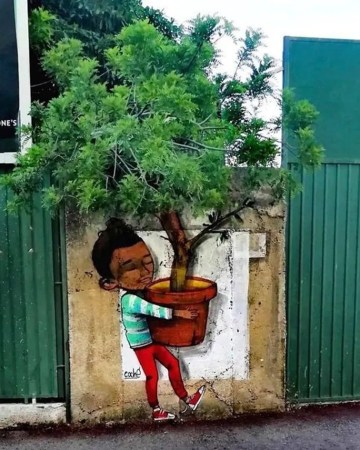 🤗 Hugging the Tree
-
 🎹 Clem’s Sidewalk Show — By David Zinn
-
 🤲 Family Tree — By Falko One in Riebeek West, South Africa 🇿🇦
-
 🐕 Sticks for Rex — Green-Wood Cemetery, Brooklyn, New York, USA 🇺🇸
-
 🚉 “Gare de Peychagnard-Crey” — By NESSÉ in Le Crey, Susville, France 🇫🇷
-
 🥕 Vegan Wolf — By Loup y es tu in Paris, France 🇫🇷
-
 🌊 A Floor That Rolls Like a Wave — Antakya, Turkey 🇹🇷
-
 🏙️ Roman London Below the Skyline — London, UK 🇬🇧
-
 🧻 A Little Help — The Thinker in San Francisco, USA 🇺🇸
-
 🌀 Spiral Wall — By John Bainbridge
-
 🕳️ Mélancolie — By Albert György, photographed in Geneva, Switzerland 🇨🇭
-
 📖 “Nadine and the Reading Palms” — By David Zinn in Laguna Beach, USA 🇺🇸
-
 🏠 “Dear Old Thing” — By GRAFFMATT in Bristol, England, UK 🇬🇧
-
 🌼 “Petals of Time” — By Studio Giftig in Ticonderoga, New York, USA 🇺🇸
-
 📚 “Gabriele D’Annunzio” — By Alessandro Verdi in Piazza della Borsa, Trieste, Italy 🇮🇹
Top 5 right now
See the Top 100What readers reacted to most this week.


More visual stories


More to explore


From our sister blog
Discover World Art Utopia
A few more artworks to take you somewhere else.


